







 >
>
The conveyance of cement, clinker, limestone, natural stone, quarry material, asphalt or concrete mixing plant output, sand, gravel and other mineral bulk materials is one of the most demanding tasks in bulk material handling technology. High conveying capacities, thousands of operating hours per year, abrasive materials, high levels of dust and, in some cases, high product temperatures present bucket elevators with major challenges on a daily basis. At the same time, unplanned plant downtime incurs considerable costs and impairs productivity. This makes it all the more important that a bucket elevator is not only high-performance but, above all, reliable, durable and optimally tailored to the specific process.
Depending on the application, different heavy-duty series are used within these design types. Whilst large-scale bucket elevators are designed for maximum conveying capacities and large particle sizes, more compact industrial series are particularly suitable for smaller conveying capacities and finer bulk materials. The key is not to opt for the largest possible size, but to tailor the bucket elevator precisely to the conveying task, the bulk material and the operating conditions.
The right design starts with the bulk material
Not every bucket elevator is suitable for every material. Properties such as bulk density, particle size, moisture content, temperature and flow behaviour must be taken into account as early as the planning stage. Particularly moist or sticky materials can lead to build-up, whilst highly abrasive bulk materials significantly increase wear on the conveying equipment.
One factor that is often underestimated is the coordination of bucket geometry, conveying speed and material properties. The shape and size of the buckets, as well as the speed of the belt or chain, have a significant influence on filling behaviour, emptying and material discharge. An unsuitable design can cause material backflow, increased wear or unnecessary product losses. Therefore, every bucket elevator should be designed individually for the specific application.
Belt or chain – it all depends on the application
Whether a belt or chain bucket elevator is the more economical solution depends on the specific process requirements.
Belt bucket elevators are particularly suitable for high conveying capacities at moderate temperatures and offer the advantages of quiet and energy-efficient operation. Chain bucket elevators, on the other hand, are frequently used where heavy, hot or particularly abrasive bulk materials are conveyed. They are characterised by a particularly robust design and a high level of operational reliability, even under extreme operating conditions. Ultimately, it is not the design alone that matters, but the technically optimal configuration for the specific conveying process.

The design determines the service life
In addition to the components used, the design of the bucket elevator plays a crucial role. A self-supporting, single-shaft design offers high inherent rigidity and allows for even great conveying heights without the need for complex tower structures. This reduces investment costs whilst ensuring high structural stability.Equally important are high-quality welded structures, precise manufacturing and a well-designed material flow path within the bucket elevator. Even minor design details influence smooth operation, wear and, ultimately, the service life of the entire system.
Wear protection and optional equipment
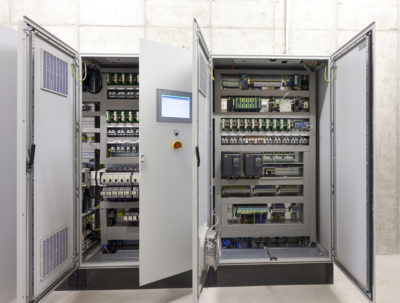
In the cement and building materials industry, every year of operation counts. That is why areas subject to particularly high stress, such as inlets, outlets and deflection points, should be specifically protected with wear linings. Depending on the application, additional features can further optimise plant operation. These include, for example, insulation to reduce heat loss with hot bulk materials, creep drives for maintenance and servicing work, or monitoring and safety systems that increase plant availability and prevent unplanned downtime.
Easy maintenance reduces downtime costs
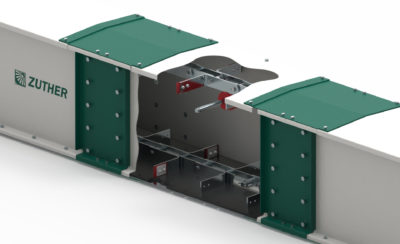
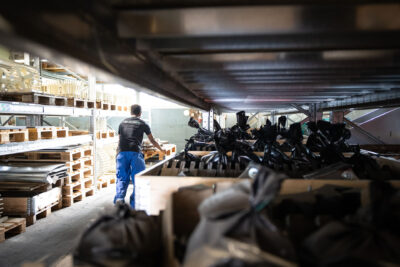
Even the most reliable conveyor systems must be inspected and maintained regularly. For this reason, care should be taken during the design phase to ensure optimum accessibility to all relevant components. Generously sized maintenance access points facilitate inspections and significantly reduce maintenance times. Equally important is the long-term availability of spare parts, so that necessary repairs can be carried out quickly and production downtime kept to a minimum.
Are you planning a new conveying system or looking to modernise an existing bucket elevator? We would be happy to assist you in designing a cost-effective and durable solution that is optimally tailored to your bulk material and your process.
 >
>
 >
>
 >
>
